Jason M-S Conaway
Dec 1, 2025
Series Introduction
This article is Part 2 of The Homeowner’s Path — a four-part series designed to bring clarity and confidence to homeowners preparing for a remodel. You can read them in any order; each pillar stands on its own while also building toward a more complete understanding of the remodel journey.
The Moment You Realize You’re Out Of Your Depth — And Why It’s Not Your Fault
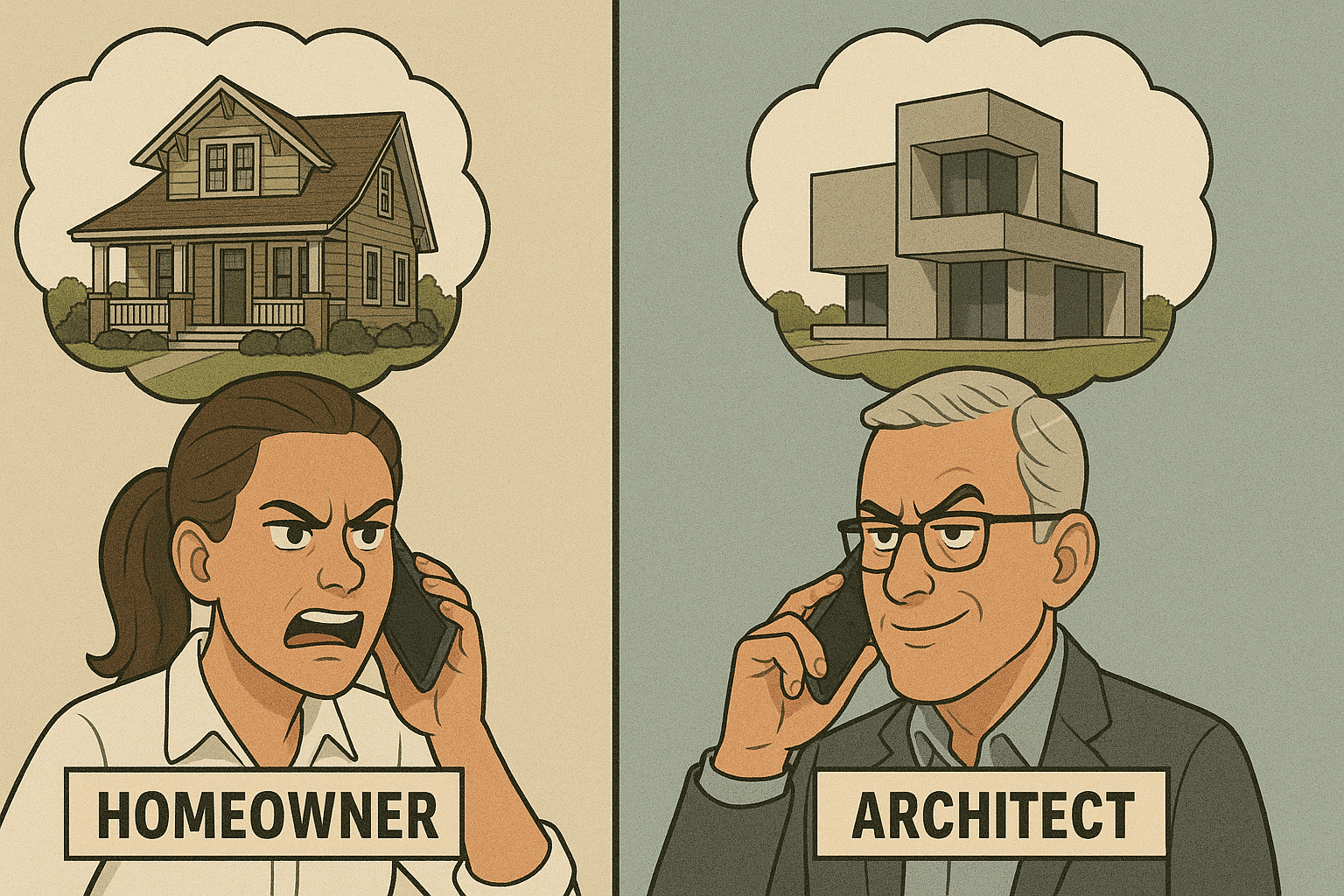
There’s a moment in almost every remodel when a homeowner is talking with their contractor, architect, or designer…
…and even though they’re following along, nodding, agreeing…
deep down, a small voice whispers:
“I don’t actually understand what’s happening.”
You hang up the call or leave the meeting, and your mind churns:
“Was that good news or bad news?”
“Is that normal?”
“Did I just say yes to something that affects cost?”
“Am I supposed to know what that means?”
This moment feels destabilizing.
But nothing is wrong with you.
It’s simply the moment you meet the second Epic Truth:
The Experience Gap — the invisible disadvantage every homeowner brings into a remodel.
And once you understand it, everything becomes clearer.
PART 1 — Professionals Remodel Constantly. Homeowners Don’t. That Changes Everything.
Professionals see remodels every day.
They breathe this world.
They speak its language.
They see patterns unfolding in real time.
They know:
how decisions ripple
where typical problems hide
what early red flags look like
what homeowners usually misunderstand
how projects drift when no one is paying attention
how one small assumption quietly becomes a big issue
Homeowners?
Most remodel once or twice in a lifetime.
Even the most intelligent, capable homeowners walk into a remodel unprepared for:
the volume of decisions
the speed of communication
the emotional whiplash
the industry assumptions
the sequencing complexity
the invisible traps
This is not a knowledge problem.
It’s an experience problem —
and experience cannot be Googled.
The gap between what professionals know and what homeowners understand is massive.
And that experience gap is where most remodel pain lives.
PART 2 — Why 5-Star Professionals Still Can’t Shield You From the Experience Gap
This is the painful truth most homeowners don’t see until it’s too late:
No professional is responsible for the entire remodel.
Not even the great ones.
Each expert lives within the boundaries of their domain:
Contractors → construction
Architects → design and drawings
Designers → finishes and aesthetics
Engineers → safety and structural logic
Inspectors → code compliance
They see the project through the lens of their work, not yours.
Even the best architect cannot:
Explain all contractor decisions
Predict all cost escalations
Keep every designer aligned
Control city permitting delays
Manage field changes
Oversee jobsite communication
Interpret crew dynamics
Track vendor timelines
And even the best contractor cannot:
Read between the lines of your unspoken expectations
Guess your design intent
Notice misalignment between drawings
Protect you from your own inexperience
Manage all coordination between specialists
Catch hidden assumptions in your conversations with others
Professionals aren’t negligent — they are focused.
Focused on their scope.
Focused on their deliverables.
Focused on the pressures of their world.
That leaves one person holding the entire remodel together:
You.
Not because you wanted the job, but because the system assigns it to you without telling you.
PART 3 — The Homeowner Fog: When You Don’t Know What You Don’t Know
Homeowners often feel guilty about things that were never theirs to carry:
“I should’ve understood that.”
“I should’ve asked more questions.”
“I should’ve known how long that takes.”
“I should’ve known costs could change.”
“I should’ve seen the signs.”
“I should’ve read the drawings more closely.”
None of this is fair.
You are stepping into:
a completely unfamiliar industry
filled with its own language
governed by invisible rules
organized through assumptions
with overlapping responsibilities
and no orientation for newcomers
You were never supposed to know this.
This is not confusion —
it’s normal human response to an abnormal expectation.
The industry expects homeowners to:
lead without training
decide without context
approve without full understanding
budget without visibility
anticipate without experience
advocate without clarity
trust without confirmation
No wonder people feel overwhelmed.
No wonder projects unravel quietly.
The Experience Gap isn’t your fault —
it is your reality.
And the sooner you see it,the more power you have to prevent the quiet chaos it causes.
PART 4 — Two Types of Pain: Loud Pain and Quiet Pain
Most homeowners fear the loud, dramatic pain — the nightmare scenarios:
Contractor steals money
Work is done wrong
A structural mistake destroys a room
A house fails inspection
Someone disappears mid-job
Those make headlines.
Those create horror stories on Reddit.
But the pain that affects most homeowners?
The pain that destroys budgets, relationships, and trust?
It’s the quiet pain — the kind you barely notice until it’s too late.
Quiet pain shows up as:
small misunderstandings
innocent assumptions
tiny decisions that ripple
subtle misalignments between pros
slow-motion drift
“I thought you meant…”
“I assumed he told you…”
mild confusion that grows
decisions approved without full understanding
tiny cracks that widen over months
costs climbing quietly
timelines shifting quietly
expectations diverging quietly
Quiet pain doesn’t explode.
It accumulates.
It sneaks in through small cracks —
and then multiplies beneath the surface.
Over time, the quiet pain often becomes the most expensive, the most stressful, and the hardest to fix.
PART 5 — A True Story: When a Simple Project Quietly Doubled in Cost
This is the perfect example of quiet pain.
A homeowner I knew wanted something small done:
a simple exterior repair
small deck improvements
some landscaping and cleanup
Nothing structural.
Nothing complicated.
Nothing that should spiral.
The contractor estimated: $15,000.
Reasonable.
Manageable.
Straightforward.
But as the project unfolded, little things cropped up:
“Do you want it this way or that way?”
“We didn’t realize this part needed adjustment.”
“This material doesn’t quite match — should we upgrade?”
“While we’re here, it might be smart to fix this, too.”
Nothing felt dangerous.
Nothing felt dramatic.
Nothing felt like a turning point.
Each choice felt small.
But each choice carried a cost ripple.
By the end of the project,
the total was over $30,000.
The contractor didn’t scam him.
The homeowner didn’t do anything reckless.
There was no moment of catastrophe.
It was quiet pain —
the Experience Gap manifesting financially.
He didn’t know what he didn’t know.
He didn’t understand the implications of each “little” decision.
He didn’t see the ripple effects forming.
He didn’t have anyone explaining the downstream impact.
He didn’t realize how quickly “small” becomes “significant.”
This is how most remodels go wrong —
not with explosions,
but with drips.
PART 6 — Why Understanding This Changes Everything
Something powerful happens the moment a homeowner understands the Experience Gap:
You stop blaming yourself.
You stop feeling embarrassed.
You stop expecting perfection.
You stop thinking you’re alone.
You stop mistaking normal confusion for personal failure.
You stop assuming professionals can fill in all the gaps.
Instead, you begin to lead with:
grounded clarity
realistic expectations
better questions
emotional steadiness
alignment-focused effort
a sense of control rather than fear
This doesn’t eliminate the challenges —
but it eliminates the surprise of them.
And that’s often the difference between a remodel that feels chaotic and a remodel that feels manageable.
Bridge To Epic Truth #3
Now that you understand:
the system is fragmented
the Experience Gap is real
and no professional oversees the whole journey
…it’s time for the next truth: